
What you need to know in 30 seconds
- Quartz is the low maintenance winner (nonporous, never needs sealing) but its resin binder is the weak point in Texas: it’s sensitive to hot pans and to strong sunlight, and manufacturers void warranties for outdoor use.
- Granite is the Texas workhorse. Natural stone has no resin, so it shrugs off heat and UV, and per 2026 pricing data it runs $60 to $150 per square foot installed. The cost is resealing every year or two.
- Butcher block is the budget and beauty play with a maintenance contract attached: regular oiling, water vigilance near sinks, and seasonal wood movement in our humidity swings.
- 2026 installed cost averages: quartz around $70 to $120 per square foot, granite $60 to $150, butcher block often the cheapest entry with woods starting near $15 to $50 per square foot in material.
- Our favorite Texas answer is the hybrid: stone on the perimeter, butcher block on the island, and granite only if the countertop lives outdoors.
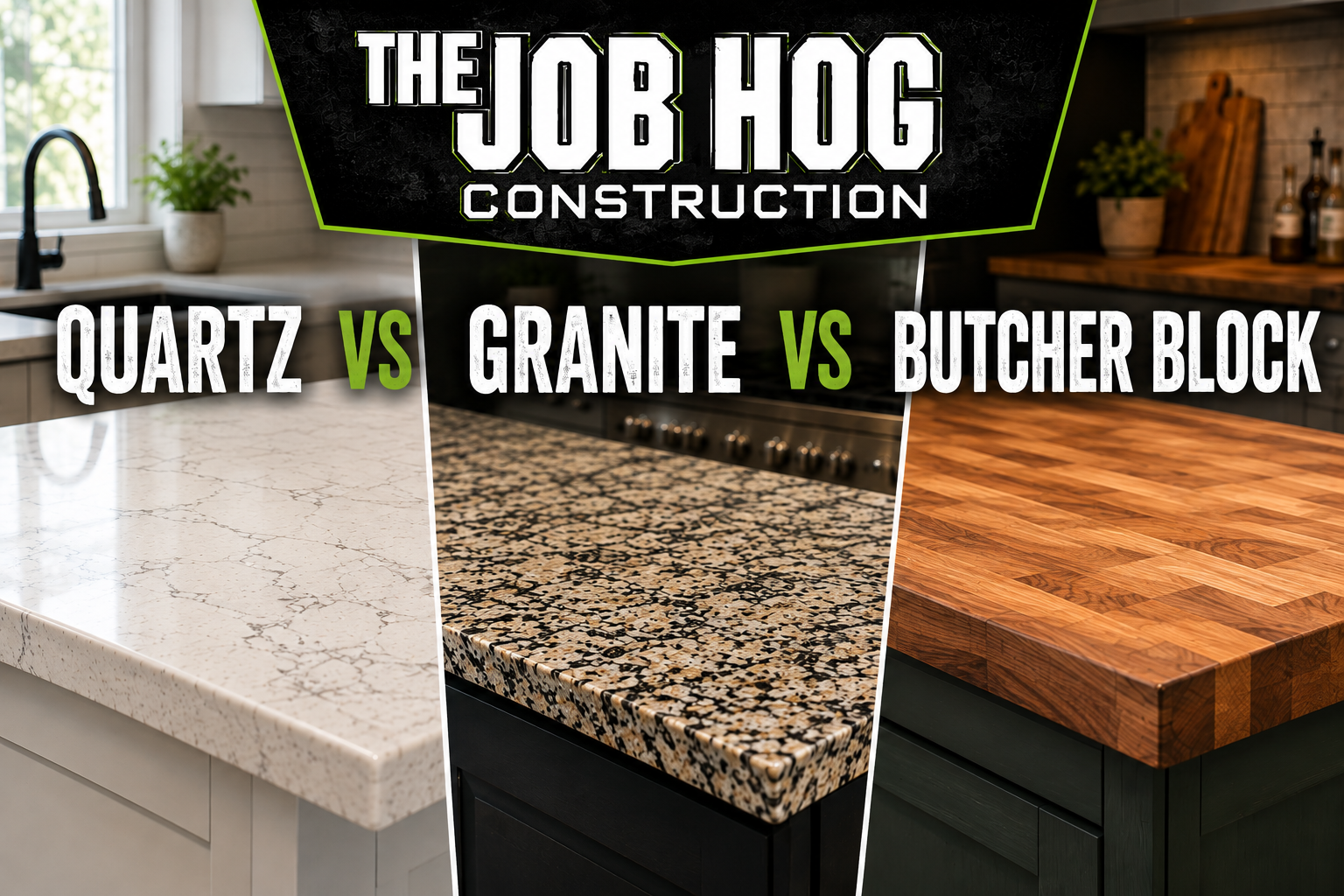
Quartz vs granite vs butcher block is the countertop debate in almost every kitchen we build, and in Texas the right answer depends on two things nobody puts in national comparison charts: how much sun your kitchen gets and how you actually cook. We install all three across North Texas kitchen remodeling projects, and each material has a kitchen where it’s clearly the right call and a kitchen where it will disappoint you within five years.
So instead of a generic pros and cons list, here’s the comparison the way we’d walk you through it at your own kitchen island, Texas conditions included.
The quick comparison
| Factor | Quartz | Granite | Butcher block |
| Installed cost per sq ft (2026) | $70 to $120 | $60 to $150 | Often lowest entry; wood from $15 to $75 material |
| Heat from pans | Trivets required; resin can scorch | Excellent resistance | Can scorch; sand out minor marks |
| Texas sun exposure | Resin can yellow near big windows | Unaffected by UV | Can mellow in color; refinishable |
| Sealing and upkeep | None; wipe clean | Reseal every 1 to 2 years | Regular oiling, prompt spill cleanup |
| Outdoor kitchens | No; warranties void outdoors | Yes | No |
| Repairability | Chips are hard to fix invisibly | Chips can be filled | Sand and refinish restores it |
Quartz: the low maintenance favorite, with two Texas caveats
Quartz took over American kitchens for a good reason. It’s engineered from roughly 90 to 95 percent crushed quartz bound with polymer resins, which makes it nonporous: no sealing ever, near total stain resistance, and a wipe with mild soap as its entire maintenance plan. Colors and patterns are consistent slab to slab, which matters when your kitchen needs three matching pieces.
The resin that makes all of that possible is also the catch, twice over, and Texas amplifies both.
Caveat one is heat. Granite Depot’s guidance notes quartz is more susceptible to thermal shock than granite because the resin doesn’t handle rapid temperature swings, so hot pans go on trivets, always. Per SlabWise’s 2026 discoloration guide, moderate to severe heat damage permanently alters the resin and can’t be polished away.
Caveat two is sunlight, and this is the one Texas kitchens actually hit. Dynamic Stone Tools’ April 2026 materials guide explains that UV exposure causes the resin binder to yellow or fade over time, that indoor countertops beneath large south facing windows or beside glass patio doors receive substantial exposure, and that most quartz manufacturers explicitly void warranties for outdoor use. SlabWise’s 2026 guide adds that UV yellowing is chemically permanent, most visible on white and light slabs near big windows. A bright Texas kitchen with a wall of west glass is exactly that scenario, so if that’s your kitchen and your heart is set on white quartz, plan UV filtering window film or generous shading into the project.
Granite: the Texas workhorse
Granite is the material that simply doesn’t care about our climate. It’s natural stone with no resin binder, and per SlabWise’s 2026 comparison, that makes it immune to the heat and UV discoloration that affects quartz. Hot cast iron straight off the burner is a non-event. The afternoon sun pouring through your breakfast nook windows does nothing. And if your project includes an outdoor kitchen or patio, granite is the one material of these three that belongs out there.
Every slab is also one of one. The veining and mineral movement in your granite exists nowhere else, which is either the whole point or a sourcing headache depending on your taste; matching multiple slabs takes more care than with quartz.
The tradeoffs are honest and manageable. Granite is porous, so it needs sealing on a recurring schedule; Grace House Studio’s December 2025 comparison puts it at every 1 to 2 years, a 20 minute wipe on a job you can do yourself. It can chip at edges, though chips can usually be filled far less visibly than quartz repairs. On cost, SlabWise’s 2026 data puts granite at $60 to $150 per square foot installed, with Angi’s 2026 comparison noting standard builder grade slabs start around $40 to $60 per square foot in material, which is why granite frequently undercuts quartz at the entry level.
Butcher block: warmth with a maintenance contract
Nothing changes a kitchen’s feel like wood. Butcher block brings warmth stone can’t, it’s quiet, it’s forgiving to dropped glassware, and it’s the one surface here you can genuinely renew: scratches, scorch marks, and stains sand out, and a refinished top looks new in an afternoon. Per Angi’s April 2026 comparison, it’s often the least expensive path too, with woods like red oak starting around $15 to $50 per square foot in material.
Now the contract you’re signing. Wood is porous and alive. It needs regular oiling (Grace House’s 2025 comparison describes monthly oiling plus constant water vigilance), spills need prompt attention, and the area around an undermount sink is its known failure zone. Texas adds a wrinkle the national guides skip: wood moves with humidity, and our climate swings between muggy stretches and weeks of bone dry air conditioning, so seams and end grain need proper finishing and a fabricator who accounts for seasonal movement.
Resale is the other honest note. Grace House’s comparison reports butcher block typically recoups 50 to 60 percent of its cost, below stone, because some buyers read wood counters as upkeep. Our take: that’s a reason to use butcher block strategically rather than avoid it.
What each costs in a typical Texas kitchen
Per 2026 published pricing, quartz runs $70 to $120 per square foot installed per Integrity Stonework’s material guide, granite $60 to $150 installed per SlabWise, and butcher block spans the widest range, from budget maple and oak up to premium walnut, with Angi’s 2026 data putting the average butcher block project around $3,750 versus $4,500 for quartz.
Two cost behaviors worth knowing before you shop. First, the ranges overlap heavily, so the real driver is the specific slab or species, not the category; an exotic granite costs more than a builder grade quartz. Second, fabrication details (edge profiles, cutouts, waterfall ends, backsplashes) move the number as much as the material does. Get your quotes itemized so you’re comparing slabs, not bundles.
Our Texas recommendation: match the material to the window and the cook
After years of installing all three, here’s how we’d actually steer you.
Cook seriously with hot, heavy cookware? Granite around the range. It’s the surface that treats a 500 degree pan as a Tuesday. Want zero maintenance and a bright uniform look, and your kitchen doesn’t take direct afternoon sun? Quartz, no hesitation. Big west facing windows or a sun drenched breakfast bar? Granite, or quartz with UV film planned from day one, and skip white quartz in the hottest light. Building an outdoor kitchen? Granite is the only one of the three that goes outside.
And the answer we find ourselves recommending most: the hybrid. Stone (quartz or granite) on the working perimeter, butcher block on the island. SlabWise’s 2026 guide endorses the same pairing for a practical reason we see play out constantly: the island gets the warmth and the knife friendly prep surface while staying away from the sink water that shortens wood’s life, and the perimeter gets the durability. It also trims cost, since the island is where a premium slab would have cost the most. If you’re interviewing builders for a kitchen project, our guide on questions to ask before hiring a remodeling contractor includes the fabrication and warranty questions countertop shoppers forget.
Frequently asked questions
Does quartz fade in the Texas sun?
It can, near strong direct light. The resin binder in quartz is UV sensitive, and 2026 industry guides report permanent yellowing on slabs that sit in prolonged direct sunlight, most visibly on white and light colors near large windows or glass doors. Ordinary indirect daylight is not a problem. For sun drenched kitchens, choose granite or plan UV filtering window treatments with the quartz.
Can you put hot pans directly on quartz or granite?
On granite, generally yes; natural stone handles direct heat well, which is why it’s the pick for serious cooks. On quartz, no. The resin is vulnerable to thermal shock and scorching, heat damage permanently alters it, and repairs are difficult, so trivets are mandatory. On butcher block, also no, though minor scorch marks can be sanded out.
Which countertop needs the least maintenance?
Quartz, and it isn’t close. It never needs sealing and cleans with mild soap and water. Granite asks for resealing every 1 to 2 years, a quick DIY task. Butcher block asks the most: regular oiling, prompt spill cleanup, and vigilance around the sink, in exchange for being the only surface you can fully renew by sanding.
Is butcher block sanitary for food prep?
Yes, when it’s maintained. A properly oiled, closed grain hardwood surface is safe for prep, and it’s the only one of the three you can cut on directly, though knives will mark it. The rules are simple: keep it oiled so liquids bead instead of soak, clean spills promptly, and refinish when the surface wears. Open grain, poorly sealed wood is where problems start.
Which countertop is best for resale value?
Stone. Quartz and granite carry the broadest buyer appeal, while comparison data published in late 2025 puts butcher block’s typical cost recovery at 50 to 60 percent, partly because buyers price in the upkeep. If resale is near term, put stone on the perimeter; if you’re staying, build the kitchen you want and use wood where it makes you happy.
Can I use quartz in an outdoor kitchen?
No. Continuous UV exposure rapidly degrades the resin binder, and most quartz manufacturers explicitly void their warranties for outdoor installations. For a Texas patio kitchen, granite is the right choice among these three; it has no resin to break down and handles sun and heat natively.