
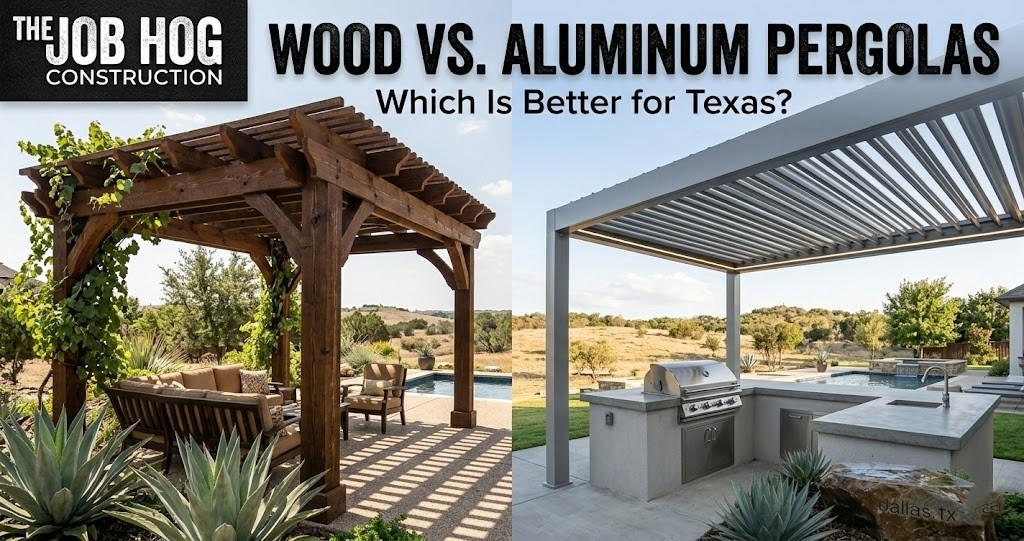
If you are researching wood vs. aluminum pergolas for your Texas home, you will find strong opinions on both sides online. Wood advocates point to natural beauty and lower upfront cost. Aluminum advocates point to zero maintenance and superior longevity. Both are making valid points, but neither side fully accounts for what North Texas’s specific climate actually does to each material over time.
This guide cuts through the noise with a direct, side-by-side comparison across every category that matters for DFW homeowners: cost over ten years (not just at installation), UV and heat performance, hail resistance, maintenance reality, and long-term condition. The verdict may surprise homeowners who have been leaning toward wood-based products based solely on upfront price.
This is a cluster article from our ultimate guide to luxury outdoor living in North Texas. For pergola pricing details, visit our luxury pergola construction service page.
Wood vs. Aluminum Pergola: Full Head-to-Head Comparison for Texas
Before the detailed breakdown, here is the complete side-by-side. Red rows flag where wood significantly underperforms in North Texas conditions. The navy verdict row at the bottom is The Job Hog’s recommendation based on 17 years of building both in this climate:
| Category | Wood Pergola | Aluminum Pergola |
|---|---|---|
| Upfront Cost (12×16) | $7,000 – $18,000 | $18,000 – $38,000 |
| 10-Year Total Cost (incl. maintenance) | $12,000 – $28,000+ | $18,000 – $38,000 (same no maintenance) |
| Texas UV Resistance | Poor greys & surfaces crack in 1-2 seasons | Excellent powder-coat rated 25+ years |
| DFW Heat Performance | Warps with repeated expansion/contraction cycles | Dimensionally stable no warping ever |
| Hail Resistance | Surface damage common; structural damage possible | Fully resistant designed for outdoor exposure |
| Maintenance Required | Annual: clean, sand, re seal, inspect for cracks | None wash down occasionally if desired |
| Lifespan in North Texas | 8-15 years with maintenance / 3-5 without | 30-50+ years with zero maintenance |
| Repair & Replaceability | Individual boards replaceable matching difficult | Factory components exact match guaranteed |
| Design Flexibility | Limited to standard sizes; custom cuts expensive | Fully custom sizing, colour matched to any home |
| Louvered Option Available | No structure not suited to louvered systems | Yes full motorised louvered upgrade available |
| Colour Options | Natural wood tones; paint possible but adds maintenance | Hundreds of powder coat colours; fade resistant |
| Environmental Credentials | Natural material FSC certified options available | Recyclable; long lifespan = lower lifecycle footprint |
| The Job Hog Verdict | Viable for covered/shaded areas with maintenance commitment | Natural material FSC-certified options available |
* Red rows = categories where wood underperforms significantly in DFW conditions. Orange = notable caveat. Green = area of genuine wood advantage. Navy verdict row = The Job Hog’s recommendation based on 17 years in North Texas.
Why the Texas Climate Is Unusually Harsh on Wood Structures
Most content comparing wood and aluminum pergolas is written for a national audience – climate zones that include Seattle, Chicago, Atlanta, and Dallas. North Texas’s climate is an outlier in almost every relevant measure, and understanding why matters before choosing a material:
🌡️ What DFW’s Climate Does to Outdoor Wood Structures
UV INTENSITY: DFW’s 234 sunny days per year and low cloud cover create UV exposure that bleaches and degrades wood surface finishes 2-3x faster than northern US climates. Untreated cedar greys visibly within one summer. | THERMAL CYCLING: Summer highs of 100°F+ and winter lows near freezing create an annual temperature range of 120°F+. Wood expands and contracts with every cycle, joint gaps open, boards cup and warp, and fasteners back out over time. | HAIL: DFW ranks among the highest hail frequency regions in the US. Even pea-sized hail repeatedly impacts wood surfaces, denting soft-grain cedar and eventually degrading any surface sealer. Baseball-sized hail, not uncommon in spring, can structurally damage an older wood pergola.
Aluminum is specifically engineered to be unaffected by all three of these factors. The powder coat finish is formulated for outdoor UV exposure and does not degrade from UV radiation. The aluminum substrate expands and contracts with temperature change, but does so uniformly without warping or joint failure. And the material hardness means that even large hail leaves no lasting surface damage.
Wood Pergolas in Texas: The Full Picture
The Aesthetic Case for Wood
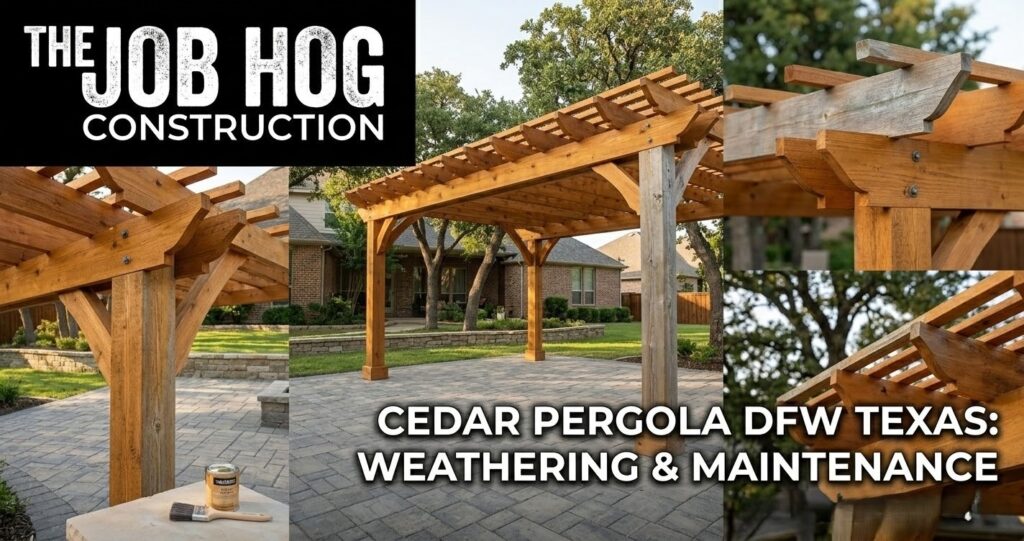
We are not dismissive of wood pergolas; the natural warmth, grain variation, and organic character of cedar or redwood are genuinely beautiful and bring something that manufactured materials cannot fully replicate. In the right application, a well-maintained wood pergola is stunning. The issue in North Texas is not that wood looks bad; it is that maintaining that appearance requires a level of ongoing commitment that most homeowners do not anticipate when they choose wood based on showroom photos.
The Real Maintenance Schedule in DFW
Here is what maintaining a wood pergola in North Texas actually looks like, not what the sales brochure implies, but what the DFW climate demands:
- Year 1: Apply a UV-blocking penetrating oil or solid stain within 6 months of installation to prevent initial greying
- Every 1-2 years: Full clean with a wood brightener, light sanding of any raised grain, re-application of UV sealer or stain, typically a full weekend of work for a 12×16 structure
- Every 3-5 years: Inspect all metal fasteners for rust staining and back out; re-tighten or replace. Check all beam and post joints for gap separation
- Every 5-8 years: Major refinish strip existing finish, sand to bare wood, apply fresh penetrating oil or solid stain. Professional refinish runs $800-$2,500, depending on size
- After any hail event: Inspect for surface denting, sealer damage, and structural fastener movement
Homeowners who commit to this schedule will have a wood pergola that maintains its appearance reasonably well. The majority of homeowners do not, and the result is visible greying, board cupping, joint gaps, and accelerated structural deterioration that brings the total useful lifespan down to 8-12 years rather than the theoretical 20-25 years possible with flawless maintenance.
Where Wood Pergolas Do Make Sense in DFW
We are not recommending wood categorically. There are specific situations where it genuinely makes sense in Denton, TX, and across DFW:
- Covered structures where the pergola is protected by an overhang or solid roof, direct UV and rain exposure are the primary accelerators of wood degradation
- Homeowners who specifically want the maintenance ritual and genuinely enjoy working with wood, some clients treat annual sealing as part of their relationship with the space
- Secondary garden or landscape structures with lower visual prominence, where weathered patina over time is acceptable or even desired
- Budget-constrained projects where the upfront cost is the primary constraint, and the homeowner understands the maintenance trade-off going in
Aluminum Pergolas in Texas: Why They Dominate the DFW Market
Zero Maintenance: What That Actually Means
“Zero maintenance” is used so liberally in outdoor building products that it has lost meaning for many buyers. In the case of powder coated aluminum pergola systems, it is genuinely accurate in the context of North Texas outdoor use. The powder coat finish is applied electrostatically and oven-cured to the aluminum substrate, bonding at a molecular level and does not peel, crack, or fade under UV radiation. It does not absorb moisture and cannot rot. The aluminum substrate does not rust. Fasteners and hardware are stainless steel or aluminium with no ferrous metal to corrode and stain the structure.
The only maintenance a powder coated aluminum pergola requires in the DFW climate is an occasional wash down with a garden hose, and even that is cosmetic, not structural. After 15 years of North Texas summers and spring hail seasons, a quality aluminum pergola looks functionally identical to how it looked at installation.
The Louvered Upgrade: Only Available in Aluminum
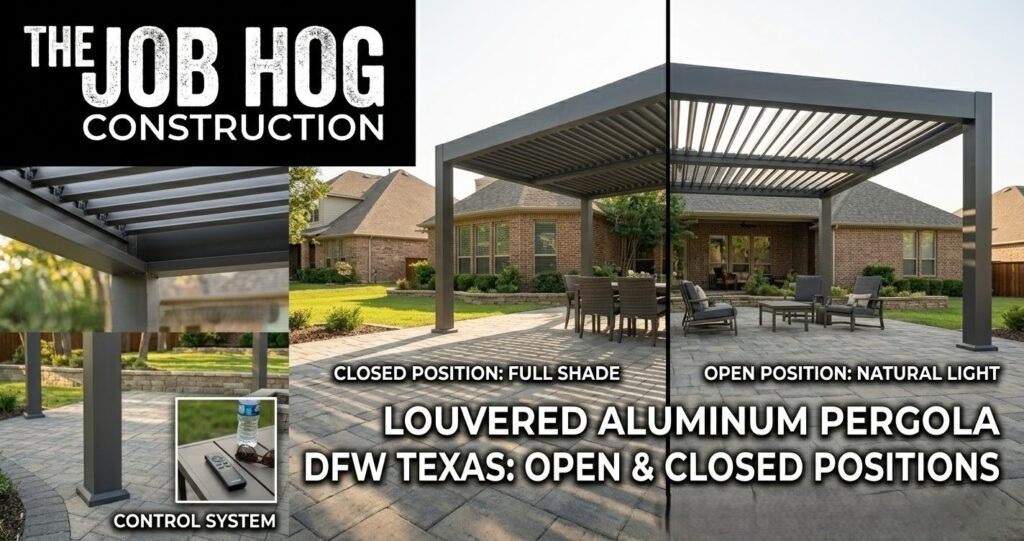
One capability that separates aluminum pergolas from wood is the availability of motorised louvered roof systems. Louvered pergolas, where the roof consists of adjustable aluminium slats that open, angle, and fully close by remote control, are the fastest growing product in the DFW luxury outdoor living market. They solve North Texas’s core outdoor living problem: the brutal afternoon sun from 2-7 PM that makes fixed roof structures uncomfortable and open slat structures essentially unusable in July and August.
Premium louvered systems include integrated gutters in the frame (rain channels away through the post footings when closed), built-in LED lighting in the louvre tracks, and weather sensors that auto-close when rain or wind is detected. None of this functionality is available in wood structures; the weight, precision tolerances, and mechanical integration required are specific to aluminium fabrication.
The Upfront Cost Reality
Aluminum pergolas cost more at installation – typically 60-100% more than an equivalent cedar structure. This is the primary reason homeowners choose wood, and it is a legitimate consideration. What the upfront comparison misses is the ten-year total cost of ownership, which erodes much of aluminum’s premium:
| Cost Category | Wood Pergola (Cedar) | Aluminum Pergola |
|---|---|---|
| Year 1: Install | $9,000 – $18,000 | $20,000 – $38,000 |
| Years 1-10: Annual sealing | $300 – $600/yr = $3,000-$6,000 | $0 |
| Years 1-10: Stain/paint (x2) | $800 – $1,500 each = $1,600-$3,000 | $0 |
| Board replacements (storm/rot) | $500 – $2,500 over 10 yrs | $0 (hail/weather resistant) |
| Year 10: Major refinish | $1,500 – $3,500 | $0 |
| 10-Year Total (est.) | $15,900 – $33,000+ | $20,000 – $38,000 (no change) |
| Condition at Year 10 | Weathered; may need full replacement | Same as day one, no deterioration |
* Estimates based on 2026 DFW contractor rates for a 12×16 cedar pergola. Maintenance costs vary by the homeowner’s DIY ability. Wood total cost narrows considerably vs. aluminum when maintenance is self-performed – but the condition gap at year 10 remains.
The ten year cost comparison shows that for many homeowners, the financial gap between wood and aluminum is much smaller than the installation price difference implies. And the condition gap at year ten is not financial; it is structural and aesthetic. A well-maintained cedar pergola at year ten is still weathering and requires increasing maintenance investment. An aluminum pergola at year ten is in the same condition as day one.
The Verdict: Which Is Better for Texas?
🏆 The Job Hog’s Honest Recommendation for North Texas
For primary outdoor living structures, such as pergolas over patios, pool surrounds, outdoor kitchen covers, and entertainment zones, aluminum is the clear recommendation for DFW homeowners. The climate is simply too harsh on wood for a maintenance free experience, and the 10 year total cost difference is much smaller than the installation gap implies. | Wood pergolas make sense in one specific scenario: covered or shaded structures where direct UV exposure is limited, for homeowners who genuinely want the natural aesthetic and are committed to the maintenance schedule. Going in with clear eyes, a maintained wood pergola in a protected location can be a beautiful long term investment.
The shortest version: if you want something you never have to think about again, choose aluminum. If you love the natural look of wood and genuinely enjoy the maintenance relationship with your outdoor structure, cedar in a well-chosen application can absolutely work in Denton, TX, and across DFW. What we caution against is choosing wood based on upfront price alone, without fully understanding the maintenance reality in this specific climate.
Frequently Asked Questions
A properly maintained wood pergola can last 15-20 years in North Texas, but the maintenance schedule is demanding: annual cleaning and re-sealing, bi-annual fastener inspection, and a major refinish every 5-8 years. Without consistent maintenance, visible deterioration begins within 3-5 years in DFW’s UV and thermal cycling conditions.
30-50+ years with zero maintenance. Premium powder coat finishes are UV stable for 25+ years, and the aluminium substrate does not rust, rot, or structurally degrade in North Texas’s climate. This is the single biggest practical advantage of aluminium over wood in the DFW market.
Yes. Motorised louvered systems require the precision tolerances, weight specifications, and mechanical integration that are specific to aluminium fabrication. No wood structure can accommodate a louvered roof system. If adjustable sun/shade/rain control is a priority, and for DFW homeowners it usually should be, aluminium is the only option.
Yes, we install both, and we’ll give you an honest recommendation based on your specific site, exposure, budget, and maintenance preferences. We serve Denton, Dallas, Fort Worth, Frisco, Plano, and all surrounding DFW communities. Estimates are always free and fully itemised.